
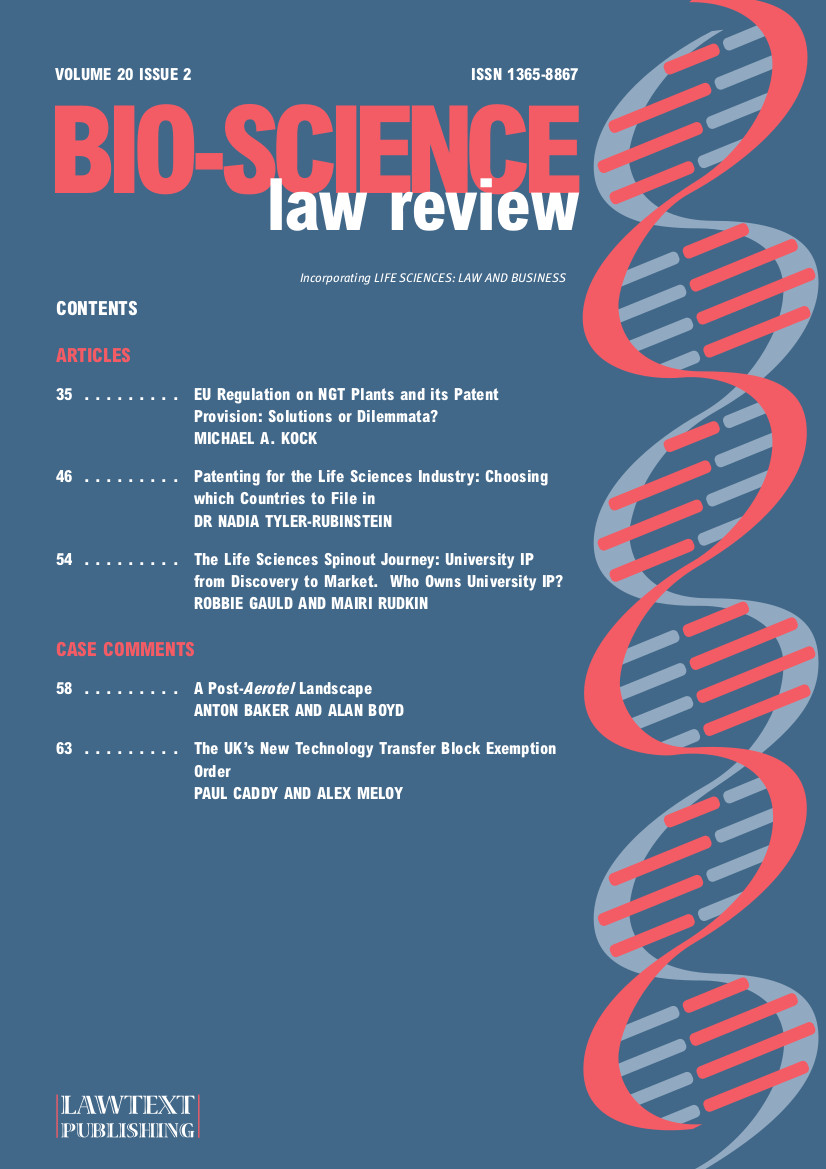
Bio-Science Law Review - Volume 20 - Issue 2
ARTICLES
EU REGULATION ON NGT PLANTS AND ITS PATENT PROVISION: SOLUTIONS OR DILEMMATA?
MICHAEL A. KOCK
dr. kock consulting, Basel, Switzerland
On 17 June 2026, almost three years after publication of the EU Commission’s initial ‘Proposal for a regulationof the European Parliament and of the Council on plants obtained by certain new genomic techniques and their food and feed’, the European Parliament followed the Council and approved the trialogue compromise for a regulation on plants obtained by new genomic techniques. While some applaud the patent-related provisions as a balanced compromise which safeguards the interests of small and medium-sized breeding companies by ensuring transparency and access, the devil could be in the details. The patent disclosure requirements, while coming with administrative burden and legal risks for applicants, are unlikely to establish ‘patent transparency’. This article discusses the patent-related provisions, their effectiveness in achieving the legislative intent, and the implications for patentees and third parties intending to use NGT-derived varieties in their breeding programmes.
PATENTING FOR THE LIFE SCIENCES INDUSTRY: CHOOSING WHICH COUNTRIES TO FILE IN
DR NADIA TYLER-RUBINSTEIN
European and UK Patent Attorney
Boult Wade Tennant LLP, London
Patents are territorial rights – there is no such thing as a single global patent that confers protection across all jurisdictions simultaneously. Yet innovation, particularly in the life sciences industry, rarely respects national borders; a novel therapeutic, diagnostic tool, or medical device may have commercial relevance across dozens of markets worldwide. Filing and prosecuting patents in every country where protection might conceivably be valuable would, however, be phenomenally expensive, and for most companies an entirely impractical ambition. The question of where to file, therefore, becomes one of prioritisation and, crucially, it is as much a commercial question as it is a purely legal one. There is no universal answer; the right strategy will differ depending on a range of factors specific to each individual innovation, from the competitive landscape and projected revenues to the regulatory environment in each territory. This article offers a checklist of topics for consideration – both commercial and patent-specific – designed to help guide that decision-making process.
THE LIFE SCIENCES SPINOUT JOURNEY: UNIVERSITY IP FROM DISCOVERY TO MARKET. WHO OWNS UNIVERSITY IP?
ROBBIE GAULD AND MAIRI RUDKIN
Marks & Clerk LLP
The legal question regarding ownership of university IP is often relatively straightforward: in most cases, university-generated IP belongs to the university. The more difficult question is how that ownership should be exercised. Decisions relating to patent protection, licensing, equity allocation and company formation can all influence whether a technology ultimately succeeds in reaching the market. As the UK’s spinout ecosystem continues to mature, success is likely to depend not only on the quality of the underlying research, but also on the effectiveness of the structures designed to transform that research into successful businesses.
CASE COMMENTS
A POST-AEROTEL LANDSCAPE
ANTON BAKER AND ALAN BOYD
D Young & Co LLP, London
In the case of Emotional Perception AI Ltd, the UK Supreme Court has removed several elements of the previous (Aerotel) framework relating to excluded subject matter. However, it has not yet replaced them with a rigid alternative, leaving a degree of uncertainty that is now being worked through at examination level. This article considers the original Aerotel process and compares it to the two different approaches that are since being considered by the UKIPO in response to the 2026 Supreme Court judgment.
THE UK’S NEW TECHNOLOGY TRANSFER BLOCK EXEMPTION ORDER
PAUL CADDY AND ALEX MELOY
Lewis Silkin LLP
The assimilated Technology Transfer Block Exemption Regulation (TTBER) has now been replaced by the Competition Act 1998 (Technology Transfer Agreements Block Exemption) Order 2026 (TTBEO). Although the TTBEO largely preserves the existing exemption framework, it introduces a number of UK-specific modifications, most notably to market share methodology, transitional provisions, enforcement powers, and definitional scope, that are of practical significance for licensors and licensees active in or engaging with the genomics, gene therapy, and broader bioscience sectors. This analysis sets out the substantive changes, identifies the compliance considerations they raise, and offers a framework for practitioners advising clients through the transition.