
Journal of Water Law - Volume 29 - Issue 2
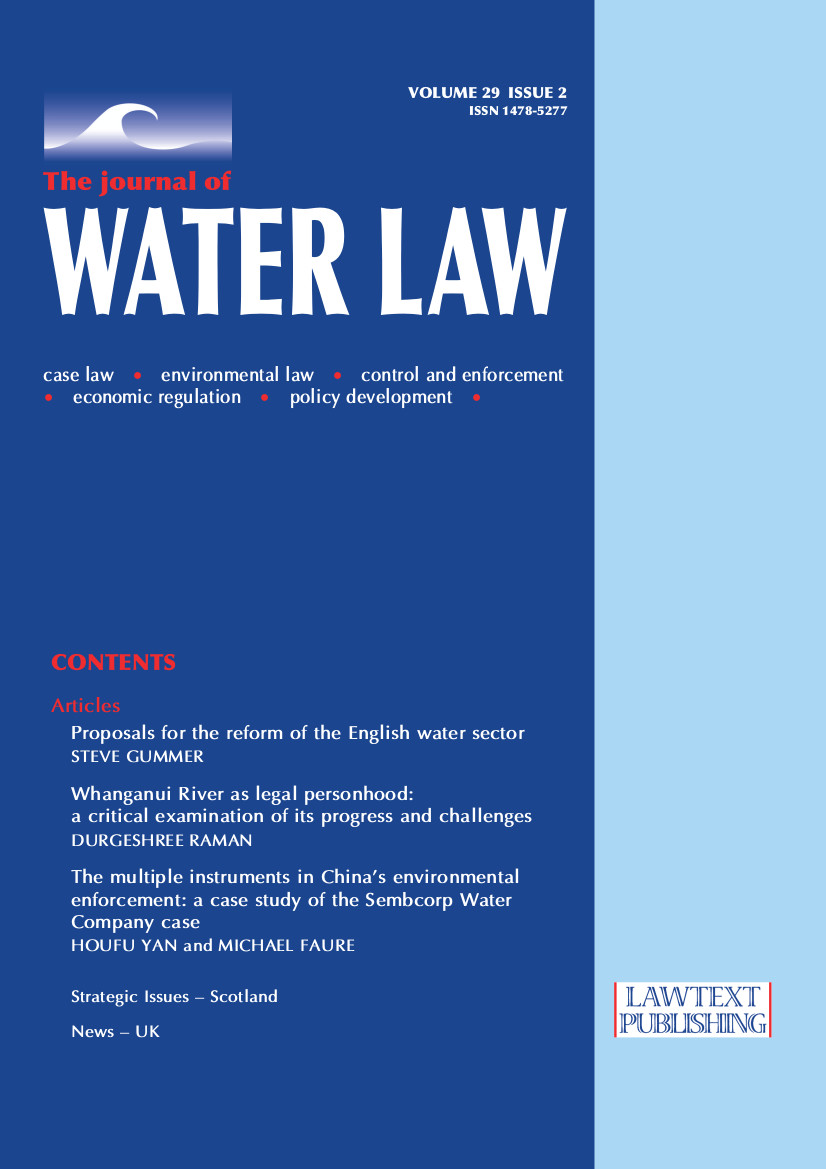
Contents
Articles
Proposals for the reform of the English water sector
STEVE GUMMER
Sharpe Pritchard LLP, London
Following the 2025 Cunliffe Report, the UK Government has launched its White Paper on wide-ranging water sector reforms. This article presents an academic reframing of the White Paper’s proposals, organising its content into a policy architecture, implementation pathway and stakeholder implications. It then analyses principal delivery risks that are likely to shape outcomes. The aim is not to contest the White Paper’s objectives but rather toidentify the institutional conditions under which those objectives might best be achieved.
Whanganui River as legal personhood: a critical examination of its progress and challenges
DURGESHREE RAMAN
University of Waikato, New Zealand
In 2014, Aotearoa New Zealand’s Te Urewera National Park became the first ecosystem in the world to be declared an environmental legal entity which effectively transferred ownership from the Crown to Te Urewera itself. However, it was not until 2017 that New Zealand’s Whanganui River became the first river in the world to be attributed legal personhood through the Te Awa Tupua (Whanganui River Claims Settlement) Act 2017. Legal personhood bestows not just individual legal identity but seeks protection and sustainability of the river as well. Given the growing popularity of the concept of legal personhood in terms of protecting the rights of nature, questions must be asked about how effective it has been in addressing environmental concerns and what those initiatives look like. Almost a decade on since the Whanganui River was granted legal personhood, the time is ripe to evaluate its objectives of protecting its rights and sustaining itself for the future. This article offers a critical examination of Whanganui River’s legal framework to assess how effective the concept of legal personhood has been in addressing issues around water quality and quantity, as well as climate change.
The multiple instruments in China’s environmental enforcement: a case study of the Sembcorp Water Company case
HOUFU YAN
Associate Professor, Law School, Beijing Normal University, Beijing, China
MICHAEL FAURE
Professor, Maastricht University, Erasmus University Rotterdam and Universitas Indonesia
The case of Nanjing Sembcorp Water Company, a subsidiary of Singapore-based Sembcorp (China) Investment Company, represents a landmark example of China’s evolving environmental liability system. From 2014 to 2017, the company illegally discharged high-concentration waste water into the Yangtze River, triggering administrative, criminal, and public interest legal actions. The case resulted in a record CNY470 million compensation, calculated using the virtual treatment costing method – CNY237 million paid in cash and CNY233 million for ecological restoration. A critical aspect of this case was the voluntary intervention of the parent company, Sembcorp (China) Investment Company, which assumed financial responsibility when the subsidiary proved incapable of full payment. This case exemplifies China’s integrated approach to environmental enforcement, combining deterrence with restoration, and offers valuable insights into corporate accountability and parent company liability. The findings have broader implications for global environmental governance, particularly in jurisdictions strengthening corporate environmental liability mechanisms.
STRATEGIC ISSUES – SCOTLAND
PROFESSOR SARAH HENDRY
Dundee Law School & the UNESCO Centre for Water Law, Policy and Science, University of Dundee
NEWS – UK
A new vision for water – UK Government launches White Paper on water sector reforms